
The Global Financial Crisis, the COVID-19 pandemic, and the more recent bout with high inflation has brought long-term uncertainty to global financial markets. As of early 2025, the landscape remains unsettled, with inflation staying stubbornly elevated, interest rates expected to remain “higher for longer” in many markets, and geopolitical tensions mounting.

The Opportunity for European Investors
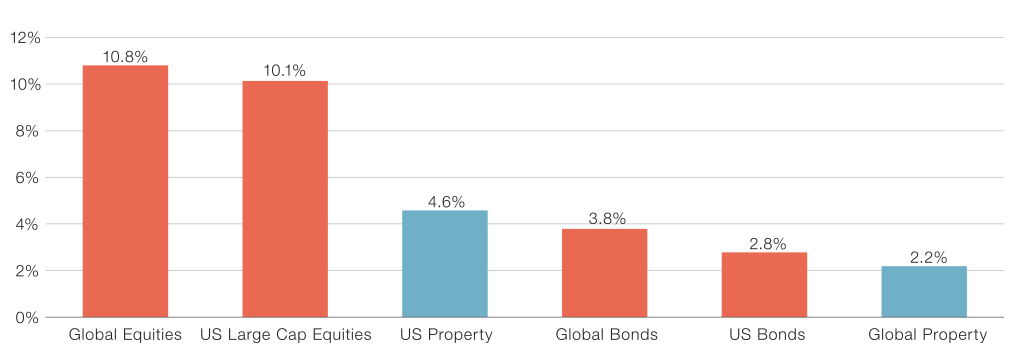
Analysis from Hines Research suggests that a real estate allocation can support an equity portfolio during periods of low growth by offering income and potential appreciation. It may also complement an underperforming bond allocation during periods of strong equity growth. Historically speaking, real estate has had lower volatility, even in periods of price declines (see exhibit below).
Downside Volatility for Various Asset Classes for the Period From 2001-20231
Disclaimer: Past performance cannot guarantee future results.
Sources: MSCI, Standard & Poor’s, Bloomberg, and Hines Research. As of 4Q 2024, but for the period from 2001-2023.
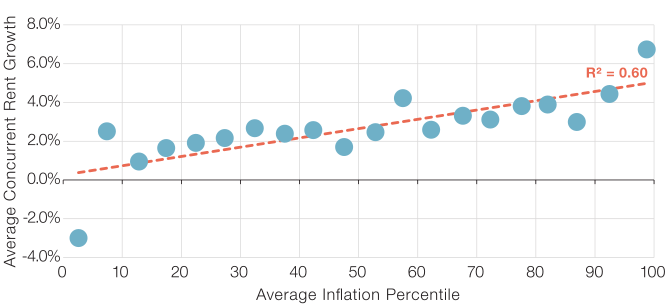
Further, real estate has historically behaved as an inflation hedge by offering capital appreciation underpinned by cash flow growth. In fact, historical data reinforces a robust correlation between global property rents and inflation. As the analysis in the exhibit below highlights, as inflation rates rose, property rents tended to increase in tandem, suggesting that the steeper the inflation curve, the more pronounced the rent growth. For investors, this served as a dual advantage: providing an avenue for attractive returns while also acting as a shield against any eroding effects of inflation.
Diversification is critical for investors navigating these challenging market conditions.2 That likely means looking beyond the commonly accepted 60 / 40 stock and bond portfolio and embracing alternative investing solutions such as real estate.
Key Takeaway
Historical Global Property Rent Growth Relative to Inflation3
Disclaimer: Past performance cannot guarantee future results.
Sources: Oxford Economics, JLL, CBRE, PMA, CoStar, and Hines Research. As of 1Q 2024.
Read more in our full whitepaper The Next Frontier: Bringing Hines Private Wealth Solutions to Europe.
1 Sources: We are using an annual index (MSCI Global Annual Property Index) of direct-owned private equity real estate total return performance from a single
source to maintain comparability. For all country level indices provided by MSCI and included by MSCI in the Global Property Index, including the
U.S., data is not yet available for 2023. Downside volatility is a measure of volatility that uses standard deviations of only negative returns, so a
measure of the relative scale of declines. We are using annual returns for all property types in USD for this analysis as that is all that is available for
the Global property index. Using annual series may understate actual peak to trough volatility, but this is true for all the asset classes shown. This is a
valid relative exercise, in our view.
- Global equities are represented by the MSCI World Index
- U.S. Large Cap Stocks are represented by the dividend yield of the S&P 500 Index
- U.S. real estate is represented by the MSCI U.S. Annual Property Index
- Global bonds are represented by the Bloomberg Aggregate Bond Index
- U.S. bonds are represented by the Bloomberg Aggregate Bond Index
- Global real estate is represented by the MSCI Global Annual Property Index (“MSCI Global Annual”)
2 Sources: Diversification does not guarantee a profit or eliminate the risk of loss.
3 Sources: Hines Research took country-level trailing annual inflation and scored each quarter’s (normal distribution) against the country’s own history. This was applied to all markets under coverage in Europe, Asia, and North America. All datapoints were bucketed into bands of 5 points (i.e., 0-5, 5-10, etc.). Then the trailing annual rent growth associated with each datapoint (each quarter for the market in question) was averaged for each band. The results are charted here. The period covered is from 1981 to present, though data availability differs by market. R2 is a measure that indicates the proportion of the variance in the dependent variable that can be explained by the independent variables in a regression model. It provides an assessment of how well the regression line fits the observed data points. R2 values range from 0 to 1, where a higher value indicates a better fit of the model to the data. An R2 value of 1 indicates that all the variability in the dependent variable can be explained by the independent variables, while a value of 0 suggests that the independent variables have no explanatory power.